Solution: Compliance & Disclosure
Combining technology and expertise to help you create credible submissions, efficiently.
Whether the law requires you to formally report your Scope 1 and 2, Scope 3, or Product Carbon Footprints, we give you the tools and data to make you compliant.
Combine trusted environmental intelligence with specialist consulting support. CarbonQuota helps you measure impact, meet reporting requirements, plan credible reductions and respond confidently to changing customer and regulatory expectations.
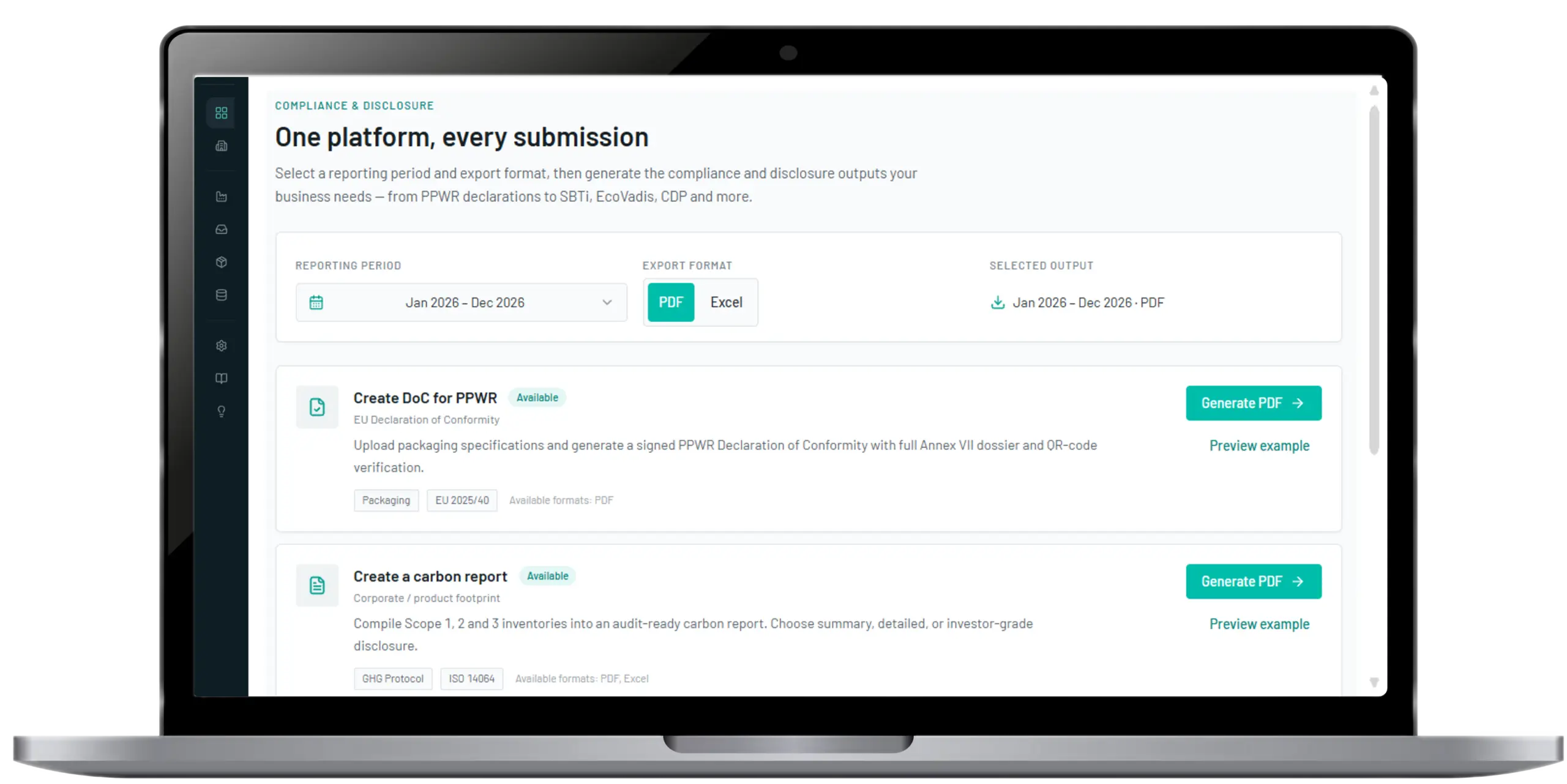
Navigate the complex landscape of environmental regulations and sustainability reporting with confidence.
The regulatory and voluntary landscape for sustainability is evolving rapidly. From the EPR and PPWR to B Corp, CDP, EcoVadis and SBTi, businesses face a growing number of requirements to measure, manage, and disclose their environmental impact.
Our team of experts can provide guidance on how these regulations apply to your business and develop strategies and to ensure you stay on top of compliance.
How CarbonQuota helps
From complex requirements to practical progress.
We understand that every organisation is unique, which is why we offer tailored solutions to meet your specific needs. Whether you’re just starting your sustainability journey or looking to take your efforts to the next level, CarbonQuota is here to support you every step of the way.
Automate data collection and analysis
Identify hotspots and opportunities for reduction
Benchmark your performance against industry peers
Communicate your progress to stakeholders.
Regulations
Whether the law requires you to officially report your Scope 1 and 2, Scope 3, or Product Carbon Footprints, we give you the tools and data to make you compliant.
Regulation
EU Carbon Border Adjustment Mechanism (CBAM)
The EU’s CBAM is a carbon price on certain imported goods, including aluminium and steel packaging.
Regulation
UK Carbon Border Adjustment Mechanism (CBAM)
Importers must report embedded emissions and prepare for customs submissions for aluminium and steel packaging to avoid penalties and cost surprises.
Regulation
EU Digital Product Passport (DPP)
Mandatory EU apparel sustainability transparency by 2027, covering materials, carbon footprint, repair/recycling guidance, and supply-chain traceability via QR code or RFID.
Regulation
California SB 253
Companies with over $1bn global revenue that involves any trade in California must disclose Scope 1, 2, and 3 emissions annually starting in 2026.
Regulation
California SB 261
Requires companies with over $500m revenue in California to prepare biennial climate-related financial risk reports aligned with TCFD.
Regulation
Public Procurement Notice 006 (PPN 006)
PPN 006 is mandatory for suppliers bidding for UK government contracts over £5m annually to include a Carbon Reduction Plan and reporting.
Regulation
Streamlined Energy and Carbon Reporting (SECR)
Under SECR large UK companies must report energy use and carbon emissions in their annual Director’s Report.
Regulation
UAE Climate Change Law
The UAE’s Reduction of Climate Change Effects Law means all organisations must measure their greenhouse gas emissions.
Frameworks
Whether it’s improving your EcoVadis score, strengthening the environmental section of your B Corp assessment, reporting to CDP, setting Science-Based Targets, or meeting Sedex standards, we give you the tools and data to make it happen.
Framework
B Corp
B Corp certification measures a company’s impact across governance, workers, community, and environment.
Framework
Carbon Disclosure Project (CDP)
CDP is a disclosure system for environmental data, especially greenhouse gas emission.
Framework
EcoVadis
EcoVadis is a global sustainability rating platform assessing environmental, social, and ethical performance.
Framework
Science Based Targets (SBTi)
Science Based Targets help companies set greenhouse gas emissions reduction goals aligned with climate science.
Framework
Sedex
Sedex promotes responsible sourcing and supply chain transparency.
Pledges
Climate action pledges like Race to Zero, The Climate Pledge, UN Global Compact, the Global Climate Action Portal, Business Ambition for 1.5°C, and the We Mean Business Coalition are shaping business expectations.
pledge
Business Ambition for 1.5°C
A global campaign led by the Science Based Targets initiative.
pledge
Race to Zero
A UN-backed global campaign that mobilises businesses, cities, and institutions.
pledge
The Climate Pledge
A commitment co-founded by Amazon and Global Optimism for companies.
pledge
Global Climate Action Portal (UNFCCC)
Official UN platform where companies, cities, and organisations register climate commitments
pledge
The UN Global Compact
The world’s largest corporate sustainability initiative.
pledge
We Mean Business Coalition
A nonprofit coalition of leading climate organizations working with businesses worldwide.
FAQs
What is ISO14001?
ISO 14001 is an international standard for Environmental Management Systems (EMS). It provides a framework for companies to manage and reduce their environmental impacts, improve sustainability, and comply with regulatory requirements. This standard helps printing companies develop and implement effective sustainability strategies.
What is the Green Claims Code?
The UK’s Green Claims Code is a set of principles designed to help businesses operating in the UK market avoid greenwashing. Organisations can be held accountable by UK regulators if they fail to comply with the guidelines. Developed by the Competition and Markets Authority (CMA), it sets out 6 key points to check your environmental claims are genuinely green: claims must be truthful and accurate; clear and unambiguous; must not omit or hide important relevant information; comparisons must be fair and meaningful; claims must consider the full life cycle of the product or service; and claims must be substantiated.
What is the UK’s Carbon Border Adjustment Mechanism (CBAM)?
It applies a carbon price to imports, including aluminium and glass packaging. It is effective January 2027. Importers must report carbon emissions and pay a levy. Companies are urged to begin complex data collection early.
What is the EU’s Carbon Border Adjustment Mechanism (CBAM)?
It applies to aluminium packaging imports. Full implementation begins January 2026. It requires quarterly emissions reporting and the purchase of CBAM certificates.
What is Sedex?
Sedex promotes responsible sourcing and supply chain transparency. Carbon footprints help manufacturers and service providers meet environmental requirements, demonstrate accountability, and strengthen trust with customers. Why it matters: brands are insisting on Sedex compliance from suppliers to build credibility and resilience in global supply chains.
How do frameworks like EcoVadis, B Corp, CDP, SBTi, and Sedex differ from regulations?
Unlike regulations, these frameworks are not enforced by law. They provide structured methods for reporting and improving sustainability. Carbon footprint data is often one of the foundations for compliance, as it underpins transparency and measurable improvement. Why it matters: for many businesses, meeting these voluntary standards is essential to maintain client relationships and secure new opportunities.
What does it mean if a company has Science Based Targets (SBTI) for tackling climate change?
Organisations that have signed up to the Science Based Targets Initiative (SBTI) are committed to making change in their operations and supply chains to reduce their carbon emissions. This must be in line with the Paris Agreement to limit global warming due to climate change to 1.5°C.
What are the Carbon Disclosure Project (CDP) and Global Reporting Initiative (GRI)?
CDP is a not-for-profit charity that runs a system for investors, companies, cities, states and regions to report on their environmental impacts. Through scoring and reporting, they are encouraging transparency to encourage sustainable business operations. Similarly, the GRI covers a range of topics for sustainability reporting.
What is Environmental, Social and corporate Governance or ESG?
This is the process of reporting on the environmental and social impacts of business activities. Along with financial reporting, it creates the ‘triple bottom line’ against which a sustainable business is measured.
What are the Sustainable Development Goals?
Otherwise known as the Global Goals, these are a collection of 17 interlinked targets to ‘achieve a better and more sustainable future for all’. Set up in 2015 by the United Nations General Assembly, they are intended to be achieved by 2030. They cover social as well as environmental topics.
What are voluntary sustainability frameworks like EcoVadis, B Corp, CDP, Science Based Targets initiative, and Sedex?
They are globally recognized standards that businesses adopt to demonstrate sustainability leadership. These frameworks aren’t legally required but help companies meet client expectations and build trust. Carbon footprint data is central because most frameworks require accurate emissions reporting to show real progress. Why it matters: adopting these frameworks can help win or maintain clients who increasingly demand compliance as a condition of doing business.
What is EcoVadis?
EcoVadis is a global sustainability rating platform assessing environmental, social, and ethical performance. Carbon footprints are critical because they influence the environmental score, which impacts supplier ratings and procurement decisions. Why it matters: a strong EcoVadis score can open doors to new business and strengthen supply chain trust.
What is B Corp certification?
B Corp certification measures a company’s impact across governance, workers, community, and environment. Carbon footprint data is essential for the environmental section, helping businesses prove they are reducing emissions and improving sustainability. Why it matters: B Corp status signals purpose-driven leadership and attracts like-minded customers and partners.
What is the Science Based Targets initiative (SBTi)?
Science Based Targets help companies set greenhouse gas emissions reduction goals aligned with climate science. Carbon footprint data is required to set, validate, and track progress toward these targets. Why it matters: SBTi commitments demonstrate serious climate action and helps future-proof your business with brands increasing requiring alignment from their suppliers.
What is CDP?
CDP (also known as Carbon Disclosure Project) is a disclosure system for environmental data, especially greenhouse gas emissions. Accurate carbon footprints are the backbone of CDP reporting, ensuring transparency and credibility in climate disclosures. Why it matters: CDP scores influence customer trust and many organisations insist their suppliers participate.
Why do manufacturers and service providers adopt frameworks such as EcoVadis, B Corp, CDP, SBTi, and Sedex?
Manufacturers and service providers use these frameworks to strengthen supply chain relationships, meet customer demands, and benchmark performance. Carbon footprints matter because they quantify environmental impact, making it possible to track reductions and validate claims. Why it matters: compliance often becomes a competitive advantage, as many clients require these standards before awarding contracts.
What are climate action pledges like Race to Zero, the Global Climate Action Portal, The Climate Pledge, the UN Global Compact, Business Ambition for 1.5°C and the We Mean Business Coalition?
They are voluntary commitments businesses make to reduce greenhouse gas emissions and align with global climate goals. Carbon footprint data is essential because it provides the baseline for setting and tracking progress.
How do pledges differ from regulations?
Unlike mandatory laws, pledges are voluntary but often align with science-based standards. Carbon data underpins these commitments, ensuring transparency and progress tracking.
What is the Race to Zero?
A UN-backed global campaign that mobilises businesses, cities, and institutions to halve carbon emissions by 2030 and achieve net zero by 2050 through science-aligned targets and transparent action plans.
What is the Global Climate Action Portal (UNFCCC)?
An official UN platform where companies, cities, and organisations register climate commitments and track progress to promote transparency and accountability in global climate action.
What is Business Ambition for 1.5°C?
A global campaign led by the Science Based Targets initiative urging companies to set science-based targets aligned with limiting global warming to 1.5°C and achieving net-zero greenhouse gas emissions by 2050.
What is the We Mean Business Coalition?
A nonprofit coalition of leading climate organizations working with businesses worldwide to halve greenhouse gas emissions by 2030 and accelerate the transition to a net-zero economy through advocacy and action.
What is the UK’s SECR (Streamlined Energy and Carbon Reporting) regulation and why is carbon data important?
It applies to quoted companies and large unquoted UK companies meeting two of these thresholds: turnover ≥ £36m, balance sheet ≥ £27m, employees ≥ 250. It requires annual disclosure of energy use, Scope 1 and 2 emissions, intensity ratios, and energy efficiency actions.
What is the UK’s PPN/006 framework and why is your carbon footprint relevant?
It is mandatory for suppliers bidding for UK government contracts over £5m annually. It requires a Carbon Reduction Plan and reporting across Scope 1 and 2 emissions, along with several Scope 3 categories covering people and supply chain impacts.
What is The Climate Pledge?
The Climate Pledge is a commitment co-founded by Amazon and Global Optimism for companies to reach net-zero carbon emissions by 2040, ten years ahead of the Paris Agreement, through regular reporting and decarbonisation strategies.
Still have more questions?
Contact usTurn environmental complexity into confident action
Talk to our specialists about the expertise, data and practical support you need to reduce risk and accelerate measurable progress..
