
Product Environmental Footprint Manager Powered by CarbonQuota
Product Environmental Footprint Manager is powered by CarbonQuota’s specialist data, methodology, technology and experience across print, packaging, display, signage, media and manufacturing supply chains.
The platform is designed to produce credible, client-ready outputs, not vague estimates. Calculations are built around transparent activity data, recognised lifecycle boundaries and curated impact factors from recognised sources.
CarbonQuota experts review and approve the underlying data before a footprint is published, helping ensure the outputs are robust enough for customer conversations, tenders, reporting and reduction planning.
- Transparent activity-based calculations
- Recognised cradle-to-factory-gate and cradle-to-customer-gate boundaries
- Curated impact-factor library
- Frozen calculation snapshots for audit-grade traceability
- CarbonQuota expert review before publication
- Outputs designed for customers, commercial teams and sustainability stakeholders
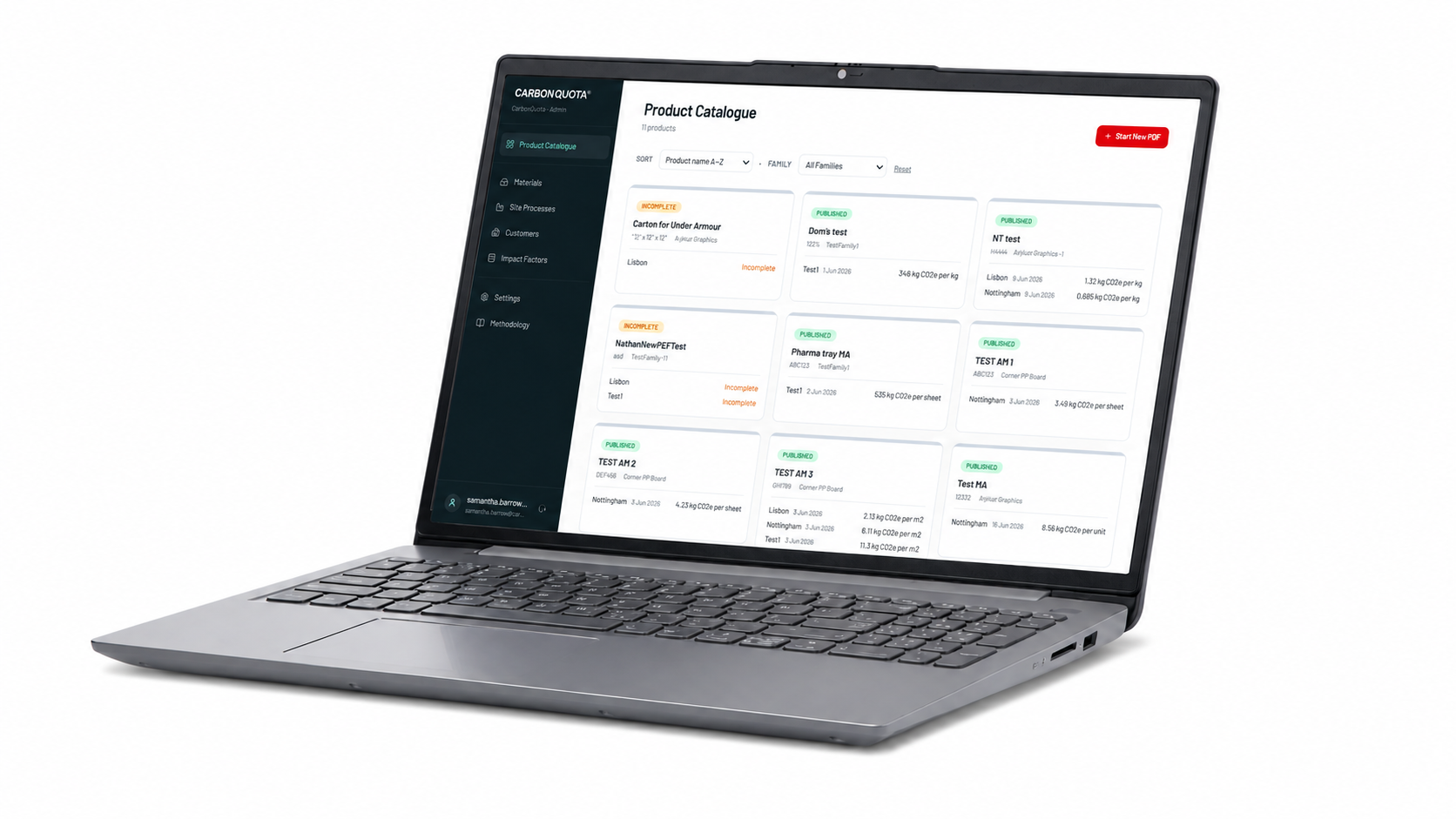





Built for complex product footprint management
Built around your business
Configure units of measure, activity types, impact-factor categories and product families to reflect how your business actually works.
Transparent footprint engine
Every footprint is calculated from the ground up using activity data and impact factors, summed across lifecycle stages.
Automatic recalculation
When an input changes, the footprint updates automatically, helping teams keep product data current.
Audit-grade traceability
Every finalised calculation is frozen as a complete snapshot, including bill-of-materials lines, factor sources and factor years.
Multi-site manufacturing
Model the same product across several production sites, each with its own bill of materials, energy grid and calculation.
Curated impact-factor library
Use a managed library of emission factors for materials, processes and transport, maintained from recognised sources.
Detailed transport modelling
Model road, rail, sea and air transport, with vehicle sub-types such as HGV, van and container ship.
Multi-supplier material blends
Calculate accurate material footprints where inputs are sourced from multiple suppliers with percentage splits.
Built-in review and approval workflow
Move products from “In review” to “Published”, with CarbonQuota expert approval before a footprint goes live.
Client-ready reports
Generate customer-specific Product Environmental Footprint reports, including transport to the customer, exported to Word, Excel or PDF

Ready to build a credible product footprint catalogue?
Product Environmental Footprint Manager helps manufacturers move from one-off calculations to scalable, client-ready environmental footprint data.
Book a demo to see how the platform can help your team calculate, manage and share accurate product environmental footprints at scale.












Talk to our team about the fastest route to credible Product Environmental Footprints on demand.
FAQs
*Blank* Do not edit
What is a Product Environmental Footprint (PEF)?
Product Environmental Footprints (PEFs) go beyond carbon to measure the full lifecycle impact of your products.This is a far more comprehensive approach that applies full lifecycle analysis (LCA) principles to measure not just carbon, but a range of environmental impact categories including water usage, land use, biodiversity, resource depletion, and more.
What standards do CarbonQuota align to?
CarbonQuota follows the general principles of the GHG Protocol, Product Life Cycle Accounting and Reporting Standard, with guidance from ISO 14040/14044 and PAS 2050.
What boundaries can you cover (cradle-to-gate, cradle-to-grave, etc.)?
We define boundaries based on your use case and data availability. We’ll agree this upfront and document it clearly in the methodology statement.
Join 450+ brands
Products & Services
Carbon Calculators
Consulting
Legislation
Integration Partners
General Information
Terms & Conditions
Privacy Policy
Cookie Policy
Contact Info
Plexal, The Press Centre
Here East
14 East Bay Lane
London E20 3BS
Email info@carbonquota.co.uk

Copyright © CarbonQuota 2026
FAQs
*Blank* Do not edit
What is CO2e?
CO2e is the standard measure for carbon footprints. It includes carbon dioxide as well as the other most important greenhouse gases created by human activities that contribute to climate change. These are converted to a much simpler to understand ‘carbon dioxide equivalent’, or CO2e. This makes it possible to track emissions across different activities and industries in a standardised way. It enables consistent comparison between industries, specifications, countries, and time periods while simplifying complex environmental impact assessments into an understandable metric.
What is a product carbon footprint, and why is it important?
Products require energy-intensive manufacturing processes, which traditionally rely on burning fossil fuels such as oil, gas and coal. This releases greenhouse gases into the atmosphere which trap more heat than normal in the atmosphere. This accelerates global climate change – so understanding and reducing a product carbon footprint means you can do something about climate change.
What is the difference between Scope 1, 2 and 3 emissions?
Scope 1 and 2 refer to carbon emissions that an organisation directly controls. Scope 1 is on-site combustion of gas and oil, fuel for company vehicles, industrial usage of greenhouse gases such as CO2, and leakage from units such as refrigeration. Scope 2 refers to the purchase of electricity, steam, heating or cooling that was generated by a third party. Scope 3 emissoins is all other greenhouse gas emissions associated with the activity of an organisation, most notably in their upstream and downstream supply chain. Scope 3 also includes other activities such as business travel, commuting, capital goods, leases, franchises and investments – along with the processing, use and end-of-life of products sold to another organisation or to the end consumer.