It seems like one of your colleagues is always up to their neck in environmental reporting – and the water is rising. Whether you are doing it to satisfy client demands, keep up with your competitors, impress new clients or simply to reduce your impact, it is becoming more complex to keep up.
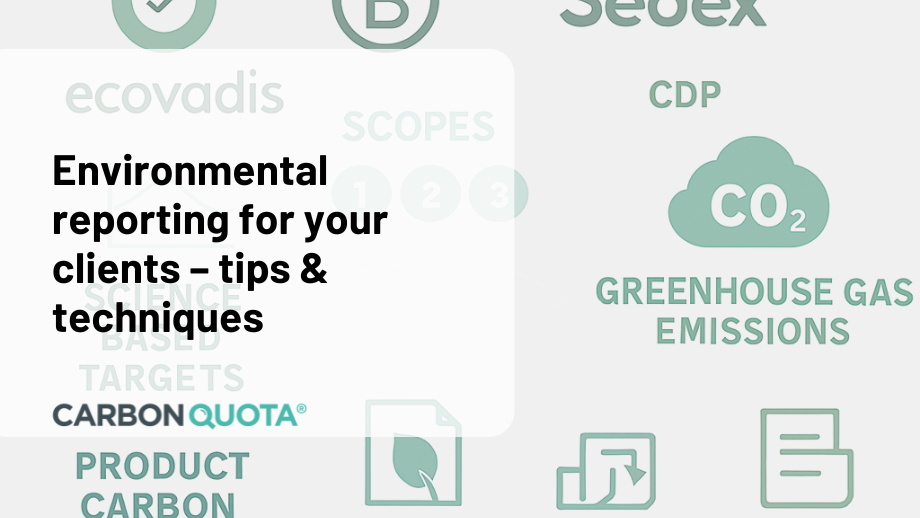
The range of options is dizzying. EcoVadis, B Corp, Sedex, CDP, Science Based Targets, Scopes 1, 2, 3, greenhouse gas emissions, water consumption, SECR, CB253, Product Carbon Footprints, LCAs, EPDs, biogenics…the list goes on.
Not only that, but the demands are getting greater and beginning to overlap. Clients are beginning to insist that their suppliers set Science Based Targets, meaning their Scopes 1, 2 and 3 need to be measured. This is also increasingly linked to improving EcoVadis ratings, and any B Corp must continue demonstrating leadership with ongoing improvements.
….the demands are getting greater and beginning to overlap. Clients are beginning to insist that their suppliers set Science Based Targets, meaning their Scopes 1, 2 and 3 need to be measured. This is also increasingly linked to improving EcoVadis ratings, and any B Corp must continue demonstrating leadership with ongoing improvements.
A necessary differentiator
Most of this is still considered “voluntary” – in other words, it isn’t enforced by legislation. However in most sectors it is a necessary licence to compete. If you don’t do it, your competitors will.
It is time-consuming, that’s pretty hard to deal with. Most medium size companies now have a near full-time employee working on environmental and social reporting, even when sustainability isn’t their core expertise.
Legislation is coming
While it may depend on your sector, your size, and your customer, you are going to be impacted. To even bid for some government contracts, a Carbon Reduction Plan is required. The Carbon Border Adjustment Mechanism is now law for certain products such as aluminium packaging – requiring a carbon footprint using data that can be traced all the way back to the smelter. Larger businesses trading in places ranging from the UK to the Nordics and California have to report on their Scopes 1 and 2. The EU’s Digital Product Passport is coming in 2027 and will require providers to provide very detailed, verified, information, data and impacts from their manufacturing supply chain. Many are even starting to gather data today.
If you are that person who is always up to their neck in environmental reporting, our job is to make your life a bit easier.
Making it easy
If you’ve done these a few times, you will have seen that there are repeating patterns. Energy consumption. Water consumption. Your buildings. Your vehicles. Your people. Your material purchases. And so on.
The trick is establishing a base set of data that can be repeatedly analysed to create different reports for different requirements at different times. When a new information request comes along, add the answer to your core set of information. Don’t think about EcoVadis as different from your Scope 1, 2 and 3 reporting. Think of them both as outputs based on the same basic information, and it’s then a lot easier to adapt them for the different requirements.
A consistent approach
If you are that person who is always up to their neck in environmental reporting, our job is to make your life a bit easier. A structured way of asking the right questions at the right time. An easy-to-use portal, with intuitive dashboards and helpful toolkits which provide the right data at the right time. Our experienced and friendly consultants help you turn that into a story to delight your clients and help you learn how to improve. Not just for next time, but to genuinely reduce your environmental impact.
Learn more about how we can support your business: Regulations & Frameworks | CarbonQuota