From Product Carbon Footprints to Product Environmental Footprints
For years, the product carbon footprint (PCF) has been the standard way to communicate the climate impact of individual goods and services. It answers a straightforward question: how many greenhouse gases are emitted across the lifecycle of this product, from raw material extraction to end-of-life?
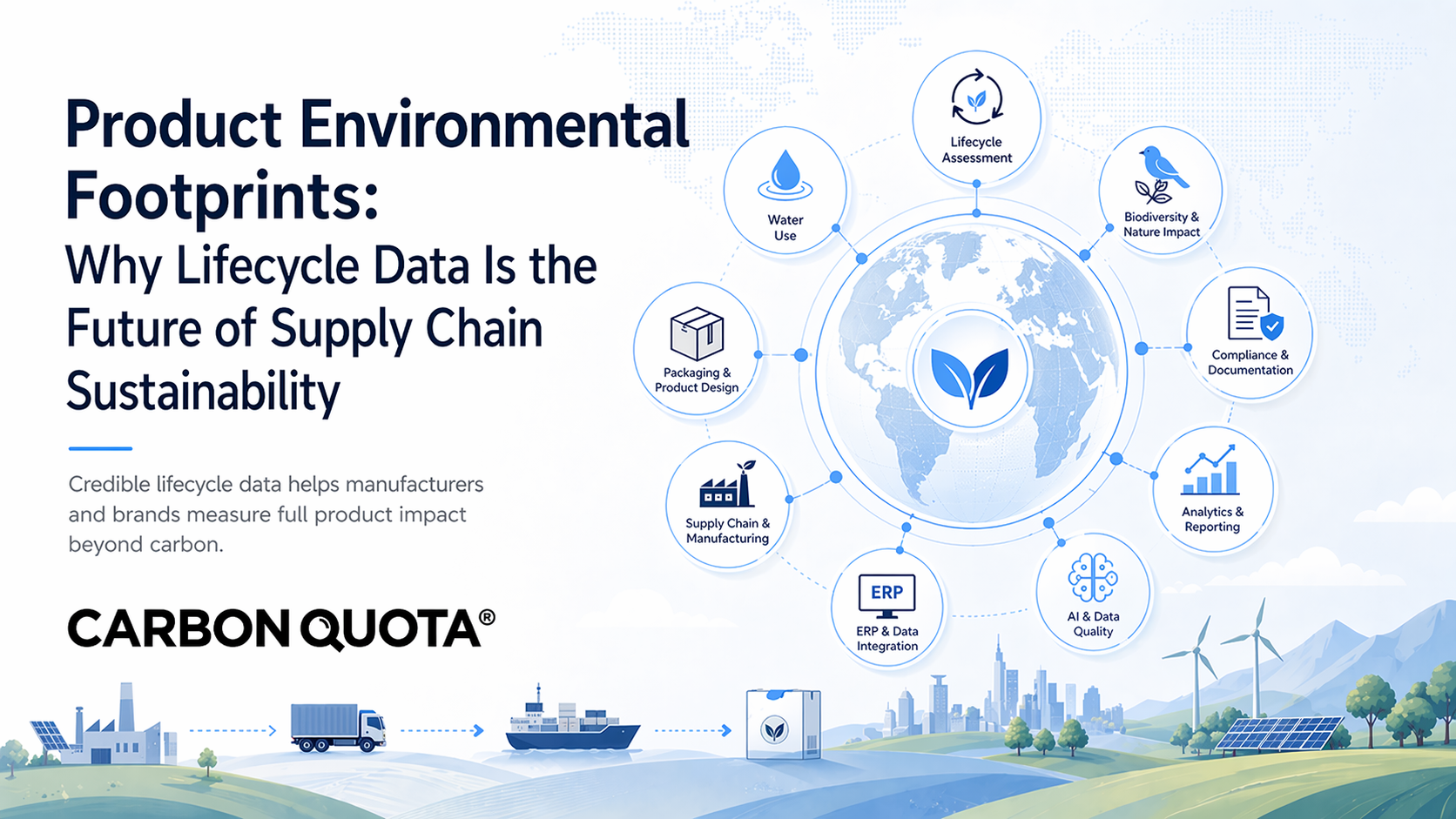
But the world is moving on. The focus is now shifting to the Product Environmental Footprint (PEF). This is a far more comprehensive approach that applies full lifecycle analysis (LCA) principles to measure not just carbon, but a range of environmental impact categories including water usage, land use, biodiversity, resource depletion, and more.
This shift is happening now. The EU’s Product Environmental Footprint methodology has been developed, tested, and refined over the past decade, with sector-specific rules (PEFCRs) now being finalised for product categories including apparel and footwear. The European Commission is embedding PEF principles into regulations like the Ecodesign for Sustainable Products Regulation and the Green Claims Directive.
For manufacturers, this is both a challenge and an opportunity. The businesses that can provide credible, data-driven PEFs to their customers will differentiate themselves in a market that is increasingly demanding environmental transparency. Those that cannot will find themselves at a competitive disadvantage – and potentially on the wrong side of regulation.
This is not a distant prospect. Brands are asking for this information today. If you are not ready when the question comes, your competitors will be.
The focus is now shifting to the Product Environmental Footprint (PEF). This is a far more comprehensive approach that applies full lifecycle analysis (LCA) principles…
The data is already at your fingertips
Here is the good news for manufacturers: you almost certainly already have the data you need. Your Management Information System (MIS) or Enterprise Resource Planning (ERP) system tracks energy consumption, material inputs, production volumes, waste streams, and more. This is the activity data that forms the backbone of a credible product environmental footprint.
What you need is a platform that connects to your existing systems and automatically translates operational data into environmental impact measurements. Platforms like CarbonQuota are built to support this kind of integration.
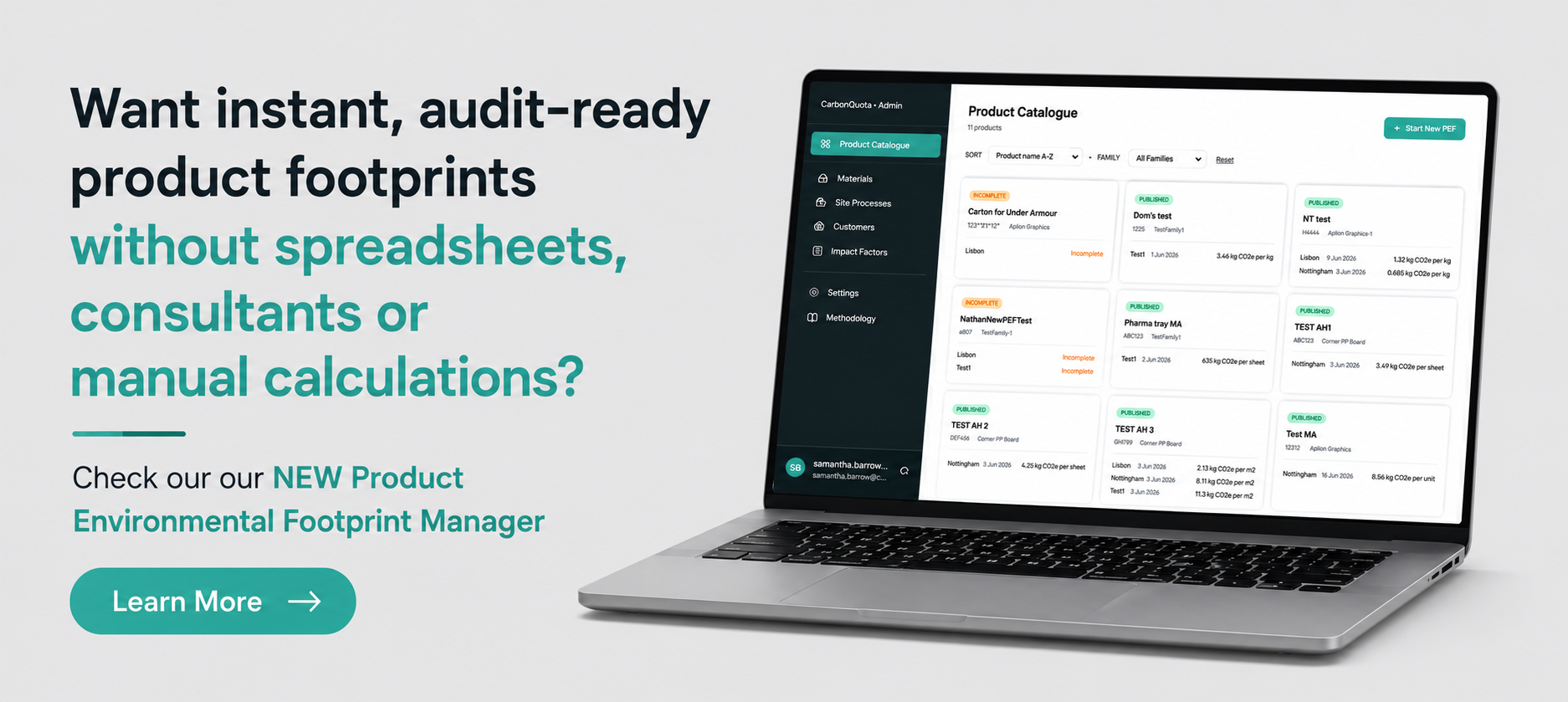
CarbonQuota integrates directly with your MIS or ERP to calculate product environmental footprints automatically. There is no additional day-to-day workload. No manual data entry. No spreadsheets. No consultants sitting in your factory asking questions. The data flows from your existing systems into our platform, and credible PEFs come out the other end.
If you are a brand, the message is equally simple: insist on automated PEFs from your suppliers. It is straightforward for them to connect to a platform like CarbonQuota, and the result is accurate, real-time product environmental data that transforms the quality of your own corporate footprint.
If you are a manufacturer, this is your opportunity to impress your clients. They are desperate for this information. They need it for their own reporting, their own framework submissions, their own investor commitments. Being able to provide credible, automated PEFs is a genuine competitive advantage – and one that can be achieved with no additional operational burden.
The data is already at your fingertips
Here is the good news for manufacturers: you almost certainly already have the data you need. Your Management Information System (MIS) or Enterprise Resource Planning (ERP) system tracks energy consumption, material inputs, production volumes, waste streams, and more. This is the activity data that forms the backbone of a credible product environmental footprint.
What you need is a platform that connects to your existing systems and automatically translates operational data into environmental impact measurements. Platforms like CarbonQuota are built to support this kind of integration.
CarbonQuota integrates directly with your MIS or ERP to calculate product environmental footprints automatically. There is no additional day-to-day workload. No manual data entry. No spreadsheets. No consultants sitting in your factory asking questions. The data flows from your existing systems into our platform, and credible PEFs come out the other end.
If you are a brand, the message is equally simple: insist on automated PEFs from your suppliers. It is straightforward for them to connect to a platform like CarbonQuota, and the result is accurate, real-time product environmental data that transforms the quality of your own corporate footprint.
If you are a manufacturer, this is your opportunity to impress your clients. They are desperate for this information. They need it for their own reporting, their own framework submissions, their own investor commitments. Being able to provide credible, automated PEFs is a genuine competitive advantage – and one that can be achieved with no additional operational burden.
What you need is a platform that connects to your existing systems and automatically translates operational data into environmental impact measurements. Platforms like CarbonQuota are built to support this kind of integration.
Why Brands Need Product Environmental Footprints from Their Suppliers
Brands are under growing pressure from stakeholders, investors, regulators, customers, and their own boards, to understand and disclose their Scope 3 emissions and broader environmental impact. For most brands, most of their environmental footprint sits in their supply chain. And that means they need granular, product-level data from their suppliers.
A product environmental footprint from a supplier is not just a nice-to-have data point. It is a crucial building block of the brand’s own corporate environmental footprint. Without credible PEFs from suppliers, brands are forced to rely on the industry-average estimates and spend-based proxies that are deeply unreliable.
This is why the pressure on manufacturers is only going to increase. Brands that take their environmental commitments seriously need accurate data from their supply chain. And the only way to get accurate data is from the source – the manufacturer’s own operational systems.
Not all product environmental footprints are created equal!
Levels of Product Environmental Footprints
Not all product environmental footprints are created equal. There are several levels of depth and complexity, and the right level depends on your industry, your customers’ requirements, and the maturity of your environmental reporting.
At the simplest level, a product carbon footprint (PCF) measures greenhouse gas emissions across the product lifecycle. This is the most established and widely requested metric, and for many businesses it is the logical starting point.
The next level up is a multi-impact product environmental footprint that covers additional impact categories: water use, acidification, eutrophication, ozone depletion, and resource depletion. This is broadly aligned with the EU PEF methodology, which defines 16 impact categories.
At the most sophisticated level, an Environmental Product Declaration (EPD) provides a comprehensive, independently verified statement of a product’s environmental impact, following international standards (ISO 14025 and EN 15804 for construction products). EPDs are increasingly requested by sophisticated buyers, particularly in construction, electronics, and industrial manufacturing.
Impact categories like water use, biogenic carbon, and land use change are being requested by more knowledgeable and demanding buyers. The trend is unmistakable and the bar is rising. Starting with a basic carbon footprint and building towards more comprehensive PEFs is a practical approach, but the direction of travel is clear.
The trend is unmistakable and the bar is rising. Starting with a basic carbon footprint and building towards more comprehensive PEFs is a practical approach, but the direction of travel is clear.
Artificial Intelligence and Data Quality
CarbonQuota has developed advanced algorithms and built a proprietary data foundation that is not publicly available. This is a critical differentiator. When an AI system is trained on publicly available data from the internet, it inherits every inaccuracy, inconsistency, and gap in that data. The resulting environmental footprints may look precise, but they are built on unreliable foundations.
No good comes of using a weak data lake. Poor-quality data self-reinforces: each calculation based on unreliable inputs produces outputs that, when referenced by other calculations, propagate and amplify the original errors. The result is a low-quality environmental footprint that cannot withstand scrutiny.
CarbonQuota’s approach is fundamentally different. Our AI looks at the high-quality data you already have in your MIS and ERP systems – your actual energy consumption, your actual material inputs, your actual production processes – and combines it with our proprietary, sector-specific datasets. The result is product environmental footprints that are accurate, defensible, and genuinely useful.
Helping Your Customers Understand Their Corporate Footprint
The ultimate benefit of providing product environmental footprints is this: you help your customers understand and reduce their corporate environmental footprint. Your PEF data feeds directly into their Scope 3 calculations, their framework submissions, and their sustainability reporting.
This is not just about compliance, it is about commercial advantage. Suppliers who can provide credible, automated PEFs make their customers’ lives easier. They reduce the burden of data collection, improve the accuracy of reporting, and demonstrate a commitment to environmental transparency that brands increasingly require.
In a competitive market where sustainability performance is becoming a procurement criterion, having this capability is a differentiator. You will win business because you have the data your customers need, presented in the format they require, updated automatically.
For a comprehensive look at the corporate perspective – including how corporate environmental footprints work, the legislation driving them, and the frameworks your customers are using – read our companion guide: Beyond Carbon: The Expanding Scope of Product Footprints
Beyond Carbon: The Expanding Scope of Product Footprints
The world is moving beyond carbon measurement. Water footprinting is rapidly gaining prominence. Stanford University’s 2026 Water Sustainability Index highlights how existing metrics fail to capture the true impact of water use in different contexts. Biodiversity, land use change, air quality, and ocean acidification are all on the trajectory for inclusion in future reporting requirements.
For product environmental footprints, this expansion is particularly significant. A product’s lifecycle typically touches multiple geographies, water basins, and ecosystems. Measuring only carbon captures one dimension of a multi-dimensional impact.
This is precisely why you need an expert partner who understands your business sector and can evolve with you as requirements expand. CarbonQuota is built for this journey – starting with carbon, expanding to water, and ready for whatever comes next.
Beyond Carbon: The Expanding Scope of Product Footprints
The world is moving beyond carbon measurement. Water footprinting is rapidly gaining prominence. Stanford University’s 2026 Water Sustainability Index highlights how existing metrics fail to capture the true impact of water use in different contexts. Biodiversity, land use change, air quality, and ocean acidification are all on the trajectory for inclusion in future reporting requirements.
For product environmental footprints, this expansion is particularly significant. A product’s lifecycle typically touches multiple geographies, water basins, and ecosystems. Measuring only carbon captures one dimension of a multi-dimensional impact.
This is precisely why you need an expert partner who understands your business sector and can evolve with you as requirements expand. CarbonQuota is built for this journey – starting with carbon, expanding to water, and ready for whatever comes next.